
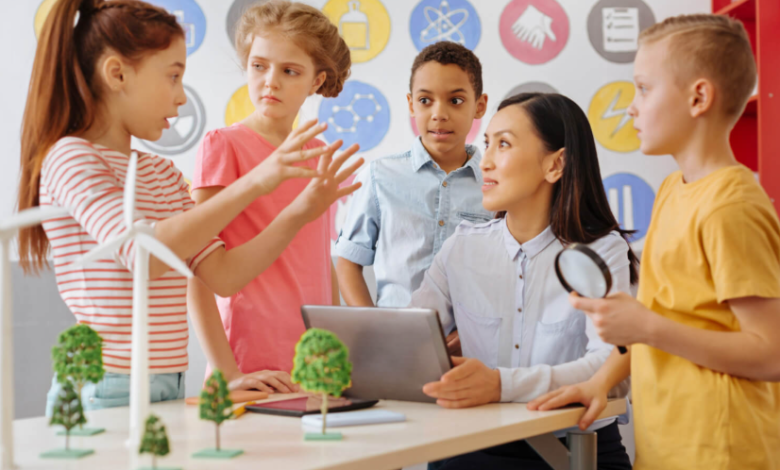
Science is not about memorizing formulas; it is about developing a lifelong interest. The right Science Education Strategies can transform classrooms into spaces where students not only absorb knowledge but also develop the skills to question, explore, and innovate. Educators can generate curiosity at an early age and, in doing so, inspire learners to embark on a journey of lifelong discovery, ensuring that science remains a prism through which they perceive the world.
Building Engagement in the Classroom
When students are involved with the material, the first step is made. This connection can be established by teachers by demonstrating the relationship between science and everyday life. Relevance ensures that the learners are more motivated. Lessons are remembered through an interactive activity, such as an experiment or a group project. These experiences help students retain knowledge longer. Storytelling is also extremely useful. Stories of discoveries or scientists make abstract ideas come to life. Teamwork promotes a feeling of community. Students get to learn with each other and develop confidence in their skills. Finally, engagement is about cultivating curiosity. Learning is a natural process once curiosity is aroused.
Connecting Students to Real-World Science
Students often struggle to see the relevance of science in their daily lives, which can lead them to seek shortcuts like requesting someone “take my online class.” Effective science education combats this by connecting learning to real-world issues, such as climate change, healthcare, and technology. By observing the influence of science on society, the learners will be more encouraged to study science in depth.
Encouraging Critical Thinking
Critical thinking helps students move beyond memorization. It also teaches them to deconstruct, assess, and challenge the information. This skill can be cultivated by the teachers formulating open-ended questions. Such questions are challenges to be explored and not answered. Arguing and deliberations are good strategies. They also push learners to support their thoughts using facts. Independent thinking is promoted by problem-solving activities. Students learn how to approach problems creatively and logically. Through critical thinking, teachers train learners to make complex decisions in the real world.
Hands-On Learning Experiences
Abstract concepts can feel overwhelming, and some students even consider options like “pay someone to do my science class” when faced with difficult material. This gap is addressed through practical experiments, simulations, and project-based learning. Such educational strategies make science more real and enable students to apply theories to practical purposes and acquire problem-solving techniques that extend beyond the classroom.
Lifelong Learning Through Science
Lifelong learning is taking the curiosity out of the classroom. There are limitless possibilities in science to acquire knowledge. This attitude can be inculcated by teachers focusing on growth over grades. It is a strategy that promotes strengths and flexibility. Perspectives are expanded by exposure to a variety of scientific fields. Students can understand that learning is a process. Mentoring and coaching are essential. Educator support encourages learners to be knowledge seekers. Lifelong learning thrives when a person develops the habit of curiosity. Science is no longer an object, but a mode of thinking.
Inquiry-Based Learning
Critical thinking is at the heart of lifelong learning. In subjects like chemistry, students may feel tempted to search for “do my chemistry class” solutions online. However, where inquiry-based education strategies are employed by educators, learners are prompted to pose questions, interpolate information, and draw their own conclusions. This is a method that makes science not about memorization but an active process.
Expanding Curiosity Through Exploration
The key concept in meaningful learning is curiosity. When students are given the push to go beyond the textbook, they start to view science as a dynamic subject that evolves with new discoveries. Exploration also creates a sense of wonder, encouraging learners to ask questions and find answers on their own. This questioning practice builds strength and flexibility that extend far beyond the classroom.
Creativity is also fostered by exploration. It is through trial and error, observation, and introspection that students form their own views of scientific ideas. This imaginative engagement enables them to bridge gaps between concepts across different fields, supporting the idea that science is integrated with all facets of life.
See also: Peak Horizon 630300272 Digital Optimization
The Role of Collaboration in Learning
Teamwork turns learning into a collective experience. By collaborating, students share ideas, challenge assumptions, and build shared knowledge. Not only does the process further enhance the knowledge, but it also builds empathy and respect towards different opinions. Discussion and group projects make learners feel responsible for their contribution. They know that cooperation, communication, and compromise can make them successful. These are competencies needed to operate in the academic and professional world.
Linking Science to Society
Science does not exist in a vacuum, as it is created and constructed by society. When relating lessons to social problems, teachers demonstrate how science affects society and policies. These Science Education Strategies help learners understand that science is not just about experiments but about making informed decisions that impact the world.
The Importance of Mentorship
Mentorship is also instrumental in advising students in their studies. A friendly mentor offers encouragement, advice, and perspective to learners to help them overcome challenges. Mentorship also encourages students to pursue something they might not have thought possible. Sharing their experience and knowledge, mentors provide examples of the importance of persistence and inquiry. Their advice assists learners not only in viewing science as a topic but also as a lifelong learning journey that may define their careers and personal development.
Conclusion
Science education is not a one-year course; it is a life-long process of curiosity, innovation, and exploration. Through a combination of hands-on learning, critical thinking, and real-life relationships, teachers can help students become interested in viewing science as a means of influencing the future. Effective Education Strategies can never kill the spark of curiosity, and it is this spark that keeps the learning process going after the classroom doors have been closed. The journey of discovery begins and ends with Science Education Strategies.

